How to Rank Higher on Google Maps Without Paid Ads

In this article
Most small businesses are invisible on Google Maps. Not because their service is bad. Not because their location is wrong. Because no one ever told them how the ranking actually works, and the tools designed to fix it were built for marketing agencies, not for dentists, lawyers, gyms, or restaurant owners running their business day to day.
This guide explains how Google Maps ranking works, what keeps most local businesses stuck on page two, and what a practical path to the top actually looks like. It also compares the main local SEO software options on the market so you can make an informed decision before spending money on something that does not fit your situation.
Why Google Maps Matters More Than Your Website Right Now
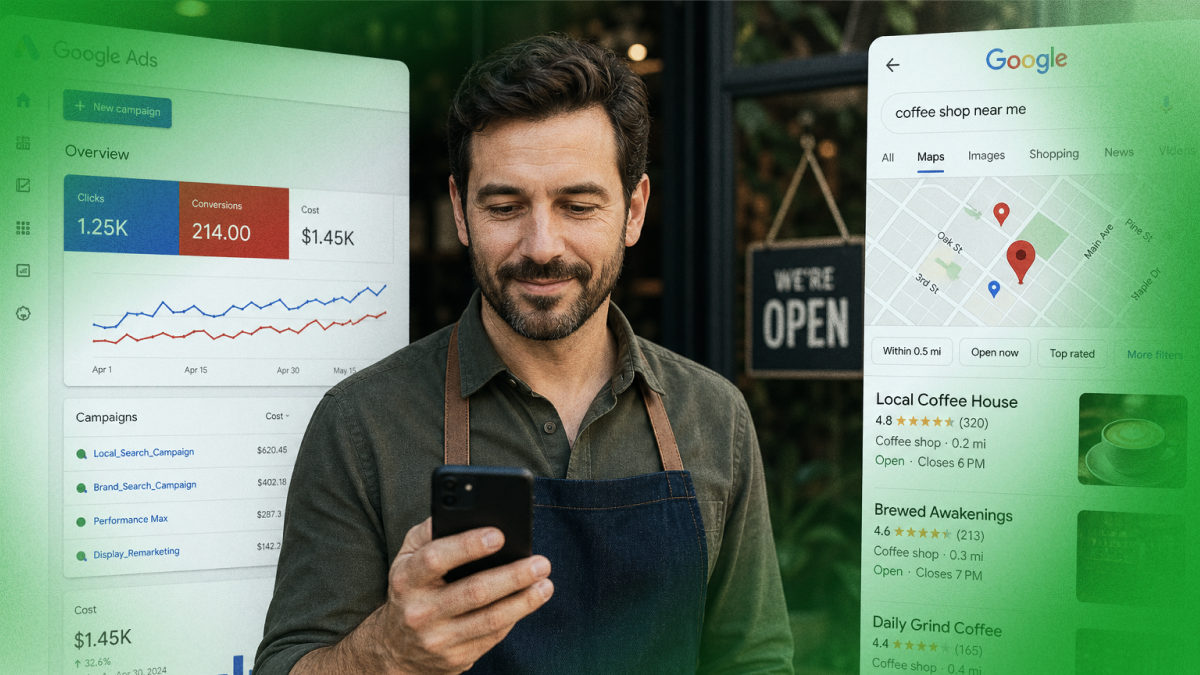
When someone searches for a dentist, a plumber, or a gym near them, they do not scroll through organic search results. They look at the map. The three businesses that appear in the local pack get the overwhelming majority of clicks, calls, and walk-ins from that search. Everyone below that pack gets a fraction of the attention.
The numbers make this concrete. Businesses in the top three positions on Google Maps receive roughly 70% of the clicks from local searches. The business in position one gets more calls in a week than a business in position five gets in a month. This is not a small edge. It is the difference between a full schedule and an empty one.
Your website matters for branding and content, but it does not put you in front of someone who is actively searching for your service in your neighborhood. Google Maps does. And ranking there is a different discipline from traditional SEO.
How Google Maps Ranking Actually Works
Google uses three primary signals to decide which local businesses appear at the top of map results: relevance, distance, and prominence.
Relevance measures how well your business profile matches what someone searched for. A search for "family dentist accepting new patients" is not the same as a search for "emergency dentist open Sunday." If your profile does not reflect the specific services someone is looking for, Google will rank a competitor who looks like a better match, even if that competitor is farther away or has fewer reviews.
Distance is straightforward: how far is the business from where the search is happening or from the location specified in the search. You cannot change your physical location, but you can control how your service area is defined and how well your profile signals the neighborhoods and zip codes you serve.
Prominence is the most complex factor and the one with the most room for improvement. It captures how well-known and trusted Google considers your business. Reviews are a major component: the number of reviews, the average rating, the recency of reviews, and whether you respond to them. Citations (mentions of your business name, address, and phone number on other websites) also contribute. So does the quality and completeness of your Google Business Profile.
Most small businesses underperform on relevance and prominence. They set up a basic Google Business Profile when they opened, added a few details, and never touched it again. Meanwhile, competitors who actively manage their profile, collect reviews consistently, and show up clearly for the right keywords are the ones Google puts at the top.
The Mistakes That Keep Most Local Businesses Stuck
Before looking at solutions, it helps to understand why so many local businesses struggle with Google Maps ranking even after they know it matters.
The most common mistake is treating the Google Business Profile like a one-time setup. Businesses fill in their name, address, phone number, and hours, then move on. Google rewards profiles that are actively maintained: updated photos, regular posts, complete service descriptions with specific keywords, and prompt responses to reviews. A static profile signals low engagement, and that affects ranking.
The second mistake is ignoring reviews until something goes wrong. Reviews are not just social proof for potential customers. They are a ranking signal for Google. A business with 200 reviews and a 4.6 average rating will consistently outrank a competitor with 30 reviews and a 4.9 average, because the volume and recency of reviews signal ongoing customer activity. Waiting for customers to leave reviews on their own produces a trickle. Building a system to ask for reviews consistently produces momentum.
The third mistake is not tracking ranking by keyword. Many business owners assume they know how they appear on Google Maps. They search their own business name and see it. But that is not how customers search. A dentist might rank well for "dentist downtown Chicago" and poorly for "teeth whitening Chicago" or "pediatric dentist near me." Without tracking specific keywords from different locations, there is no way to know which searches are being won and which are being lost to competitors.
The fourth mistake is measuring the wrong things. Traffic to the website, social media followers, general visibility scores: these are not what drive revenue for a local business. What matters is ranking position for specific keywords in the areas you serve, and whether that translates to calls, bookings, and walk-ins.
What Local SEO Software Does, and What to Look For
Local SEO software exists to solve these problems at scale: tracking ranking across keywords and locations, identifying where you stand against competitors, automating review collection, and surfacing what needs to change to move up.
The market has a handful of established players and some newer options. Here is an honest look at each.
BrightLocal is one of the most widely used local SEO platforms. It has strong reporting, rank tracking across multiple locations, and tools for citation audits. It was built primarily for SEO agencies managing dozens or hundreds of clients. That shows in the interface: it is feature-rich and data-dense, which is useful if you have a dedicated person managing SEO. For a dentist or restaurant owner who wants to understand their Google Maps ranking without learning a new profession, BrightLocal can feel like more than you need. Pricing reflects the agency positioning.
Whitespark focuses heavily on citation building, which is the process of getting your business information listed accurately on directories, review platforms, and local websites. Citations matter for prominence, and Whitespark does this part well. The limitation is scope: citation building is one input into Google Maps ranking, not the whole picture. If you need comprehensive ranking tracking, review management, and competitive analysis in one place, Whitespark alone does not cover it.
Yext is an enterprise-grade platform used by large retail chains, hotel groups, and franchise networks. It manages listings across a wide network of directories and is genuinely powerful at scale. For a small or medium business, the pricing is hard to justify and the feature set is far beyond what a local business actually needs. Yext alternatives for small businesses are popular searches precisely because business owners land on Yext, see the price, and look for something better suited to their situation.
Local SEO agencies offer a service instead of a platform. You pay a retainer, they manage your local presence. The model works for businesses that want to outsource the work entirely and have the budget for it. The downsides are cost, opacity, and dependency. Most agencies do not give you full visibility into what they are doing or why. You see monthly reports, sometimes bi-monthly, and hope the work is moving the needle. When it is not, the conversation is difficult because you do not have the data to challenge the explanation.
Paid ads on Google or Meta are frequently positioned as an alternative to organic local SEO. They are not a substitute. Paid traffic stops the moment your ad budget stops. Local SEO builds a position that keeps generating calls and walk-ins without ongoing spend. The two can work together, but businesses that rely entirely on ads for local customer acquisition are one budget freeze away from silence.
What to look for in any local SEO tool: keyword-level rank tracking from multiple geographic points, competitive visibility (how you compare to the specific businesses you lose customers to), review management that works without constant manual effort, and reporting that shows progress in plain terms, not raw data dumps.
The Access Problem Most Platforms Ignore
One friction point that comes up in almost every conversation about local SEO software is account access. Most platforms ask for access to your Google Business Profile, your Google Analytics, your Google Search Console. For a small business owner, handing over access to core accounts to a software vendor feels like a real risk. What if there is an error? What if the account gets flagged?
Leapfy works without requiring access to your Google Business Profile. The platform tracks your rankings, analyzes competitor positions, and surfaces recommendations from the outside, without touching your account credentials. For business owners who want the data and the guidance without the exposure, this matters.
How Reviews Move Your Ranking
Reviews deserve their own section because they are the most consistently underutilized lever in local SEO. Most businesses collect reviews passively: some customers leave them, most do not, the average accumulates slowly.
Google weighs reviews in several ways. Total count matters: all else equal, a business with 150 reviews ranks higher than one with 40. Average rating matters: dropping from 4.5 to 3.8 visibly hurts ranking. Recency matters: a business that got 50 reviews in the last three months signals more current activity than one with 200 reviews spread over five years. Response rate matters: Google sees whether you engage with reviewers, and so do potential customers.
Building a review system means removing friction from the process. Asking at the right moment (after a successful appointment, after a completed job), making it simple (a direct link, a QR code), and doing it consistently (every week, not just when you remember). The businesses that reach 100, 200, 300 reviews do not get there by accident. They have a repeatable process.
Real results from Leapfy clients show what this looks like in practice: a restaurant moved from a 3.0 to a 4.8 star average over several months of active review management. A gym collected 80 new reviews in the first two months. A veterinary practice reached the number one ranking position for 12 keywords in their area. These results come from consistency, not from a single campaign.
What Results Look Like, and When to Expect Them
Local SEO is not paid advertising. You do not turn it on and see calls the next morning. The timeline is different, and any platform or agency that promises instant results is telling you what you want to hear.
A realistic expectation: you will see the first signs of movement within 30 to 60 days. Rankings for some keywords will shift. Review count will increase. Profile engagement will improve. These are leading indicators that the work is having effect.
Solid, sustainable results typically take 60 to 90 days and beyond. This is when ranking improvements start translating into measurable changes in call volume, appointment bookings, and foot traffic. The timeline depends on how competitive your local market is, how established your profile already is, and how consistently the optimization work gets done.
This transparency about timelines is rare in the local SEO industry, where overpromising is common. Leapfy builds this expectation directly into its onboarding because clients who understand the timeline stick with the process long enough to see the results. Clients who expect immediate outcomes drop off right before the momentum builds.
The Leapfy Approach to Local SEO
Leapfy is a local SEO platform built for the business owner, not the SEO agency. The focus is on Google Maps and Google Search ranking for small and medium businesses with a local customer base: dentists, lawyers, gyms, clinics, plumbers, restaurants, veterinarians, and similar service businesses with a defined geographic market.
The platform tracks your ranking by keyword across the specific locations that matter to your business, compares that ranking against your direct local competitors, and identifies exactly what is keeping you below the top positions. Bi-weekly reports translate the data into plain-language priorities: what improved, what needs attention, and what to do next.
Review management is built into the workflow. The platform automates the process of requesting reviews at the right moment, tracks the response, and monitors how your average rating trends over time. No manual follow-up is needed.
The competitive analysis is local and specific. It does not compare you to businesses in other cities or to national averages. It shows you how you compare to the three or four businesses competing for the same customers in your neighborhood, with the same search terms, on the same streets.
The free diagnostic tool, "Discover My Ranking," generates an immediate report on where you currently stand: which keywords you rank for, which ones you are missing, and how your profile compares to competitors. No account access required, no credit card, no sales pressure. It is a practical starting point for understanding what the gap actually looks like.
Businesses that have been through the BrightLocal complexity, paid Yext prices they could not sustain, or run citation campaigns with Whitespark and hit a ceiling on results, find that Leapfy covers the full picture in one place with reporting that makes sense without an SEO background.
Start With Your Ranking
The most common mistake is spending time debating which platform to use before knowing where you actually stand. Run the free diagnostic first. It takes two minutes, gives you a real picture of your current Google Maps position for the keywords that matter to your business, and costs nothing.
Once you see the gap between where you are and where your competitors are ranking, the decision about whether to invest in local SEO becomes obvious. And you have the specific data to evaluate whether any platform, including Leapfy, addresses the problem you actually have.