What Is Local SEO, Really? Let Me Explain It Without the Jargon
In this article
I am Daniel, and I build Leapfy. I spend most of my days talking to people who run real local businesses, dentists, gym owners, plumbers, lawyers, and almost all of them ask me some version of the same question. "What actually is this local SEO thing, and is it worth my time?"
Most explanations they find online are written by people who seem to enjoy sounding clever. Mine will not be. I am going to explain local SEO the way I would to a friend over coffee who runs a shop and just wants more customers. No jargon, no pretending it is more complicated than it is. By the end you will actually understand how it works, what it can do for you, and what it cannot.
Let me start with the simplest version.
The plain English definition
Local SEO is the work of getting your business to show up when someone nearby searches Google for what you sell.
That is it. When a person in your town pulls out their phone and types "best barber near me" or "emergency dentist" or "plumber open now," Google decides which businesses to show them. Local SEO is everything you do to make sure your business is one of the ones it shows, near the top, where people actually look.
The "SEO" part stands for search engine optimization, which is a fancy way of saying "making yourself easier for Google to find and recommend." The "local" part means we are talking about searches tied to a place, your place, where being nearby and trusted matters more than anything else.
Why local search is its own thing
Here is something a lot of people miss. Ranking a local business on Google is a different game from ranking a big website or an online store, and the rules are not the same.
When you search for something national, like a recipe or a news story, Google shows you the best pages from anywhere in the world. When you search for something local, like a coffee shop, Google does something different. It looks at where you are and tries to show you good options close by. A brilliant coffee shop three towns over is useless to you right now. Google knows that.
So local search runs on a logic of its own. Being the biggest or the oldest does not automatically win. Being the right business, close to the person searching, and clearly trusted, is what wins. That is good news for small businesses, because it means you are not competing with the whole internet. You are competing with the other businesses in your area, and that is a fight you can actually win.
What you are really trying to win
Let me show you the prize, because it makes everything else make sense.
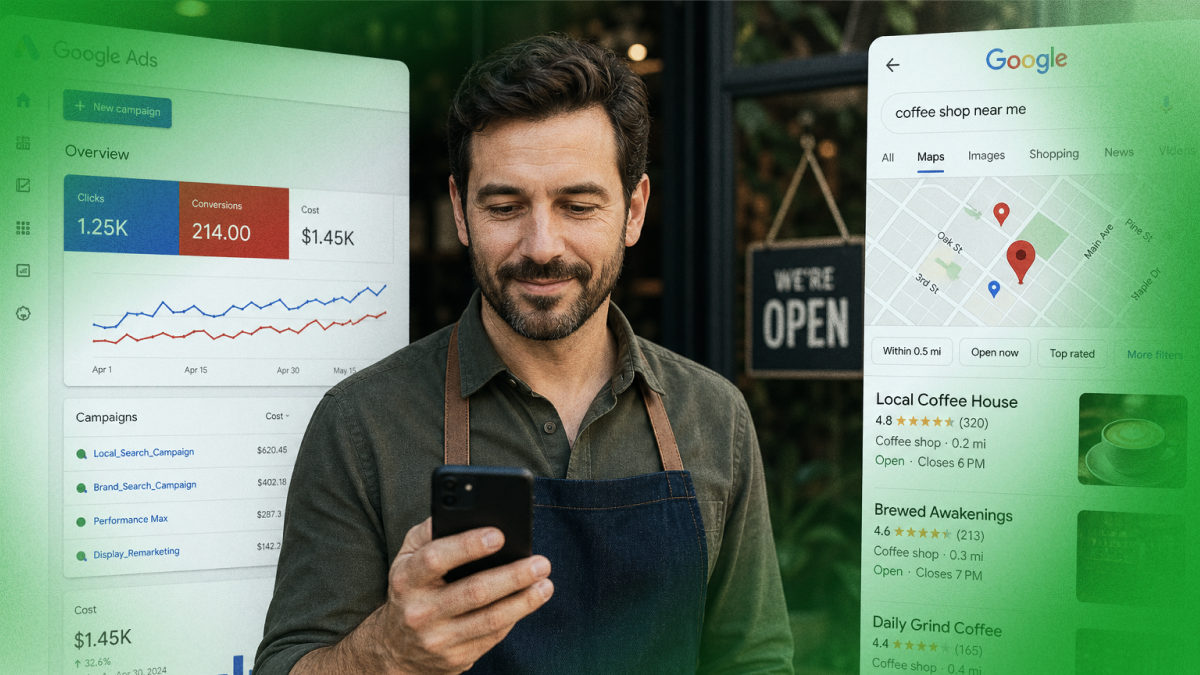
Search for almost any local service on your phone and look at the top of the results. Below the ads, you will see a little map with three businesses listed under it, each with a star rating and a button to call or get directions. That box is the thing. In the business it gets called the map pack, or the local three pack, and those three spots get the overwhelming majority of the calls.
Most people never scroll past those three. They pick one, they call, they book. So when I talk about local SEO, what I really mean is the work of earning one of those three spots for the searches that matter to your business. Everything else is detail. That is the goal.
The three things Google is actually looking at
When Google decides who gets those spots, it weighs three things. I am going to keep these simple, because once you get them, you understand the whole game.
The first is relevance. This just means how well your business matches what the person typed. If someone searches "emergency plumber" and your business clearly says you do emergency plumbing, you are relevant. If your listing is vague and barely describes what you do, Google is not sure you are the right answer, so it picks someone clearer. A lot of businesses lose here without realizing it, just because they never spelled out plainly what they do.
The second is distance. Google wants to show people businesses near them, so how close you are to the person searching matters a great deal. You cannot move your shop, and you do not need to. But this is why you might show up beautifully for people on your street and disappear for people across town. That is distance doing its job.
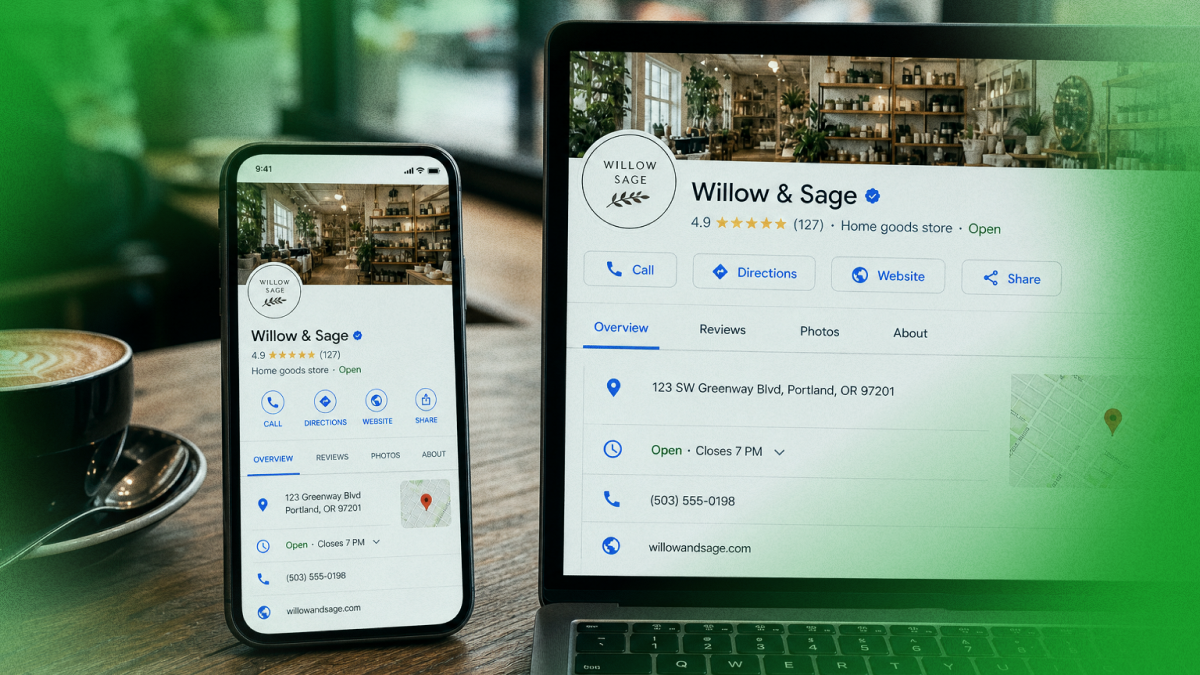
The third is prominence, and this is the big one, because it is the part you can actually grow. Prominence is how known and trusted your business looks to Google. It comes from your reviews, from your business information being consistent everywhere online, from having a complete and active profile, from looking like a real, established business that people keep choosing. Of the three, this is where most of your effort goes, because it is the one you control.
Relevance, distance, prominence. That is the engine. Everything in local SEO is just feeding one of those three.
Why it is not a magic switch
I am going to be honest with you here, because the people who are not honest about this are the ones who give the whole industry a bad name.
Local SEO is not instant. You cannot flip it on and rank tomorrow. It takes time, usually a couple of months before you see real movement and a few months more before the results feel solid. And there is a good reason for that delay, not just Google being slow for the fun of it.
Trust takes time to prove. Google will not put you in front of its users just because you showed up and asked. It wants to see that you are consistent, that reviews keep coming, that you behave like a real business over weeks and months, not just for one excited afternoon. The flip side, and this is the part I love, is that once you earn that position, it sticks. It does not vanish the second you stop paying, the way ads do. You build something that keeps working.
If anyone promises you the top spot in a week, walk away. They are either going to do something risky that gets you penalized, or they are lying. Real local SEO is a slow build that pays off and keeps paying.
What local SEO can and cannot do for you
Let me set honest expectations, because I would rather you trust me than oversell you.
What it can do is get you found by people who are already searching for exactly what you offer, in your area, and ready to call. That is the best kind of customer there is. They have intent. They are not being interrupted by an ad. They went looking, and you were there. It can do this consistently, around the clock, without you paying for every single click, and it gets stronger over time.
What it cannot do is make a struggling business succeed on its own. If your service is poor or your reviews are genuinely bad because customers are unhappy, no amount of local SEO fixes that, and honestly it should not. Local SEO makes a good business easier to find. It is an amplifier, not a disguise. If you are good at what you do and people just are not finding you, that is exactly the problem it solves.
The mistakes I see owners make over and over
Since I talk to so many business owners, let me save you some pain with the patterns I see most.
They leave their Google profile half finished, missing hours, no photos, no real description, and wonder why a more complete competitor beats them. They ask for reviews in one big burst, then never again, so the flow dries up and looks stale. They never check that their address and phone number match across the web, so old listings quietly contradict each other and Google trusts them less. And they give up at week three because nothing happened yet, right before the part where it starts working.
None of these are hard to fix. They are just easy to ignore when you are busy running the actual business, which you always are.
Where to start if you do nothing else
If you take one thing from me, take this. Start with two moves, because they give you the most for the least effort.
First, fill in your Google Business Profile completely and accurately, every field, real photos, the words people actually search for. Second, start asking every happy customer for a review, right after you have made them happy, and never stop. Those two things alone put you ahead of a surprising number of your competitors, because most of them will not bother.
Everything beyond that, the consistency cleanup across dozens of listings, tracking what your competitors are doing, keeping the reviews flowing every single week, is real work that compounds. It is also the part that quietly falls off the to do list, because it is important and boring at the same time.
Where my company fits, honestly
I am not going to pretend this article is not also about Leapfy, because that would be insulting your intelligence. So here it is, straight.
The reason I built Leapfy is that the work above is exactly the kind of thing a busy owner cannot keep up with by hand, and the agencies that do it tend to be expensive, slow, and impossible to see inside. Leapfy does the local SEO work for you, from the outside, without ever needing access to your Google Business Profile, so you stay in control of your own account. And every two weeks it sends you a plain language report showing where you rank, who you are gaining on, and what changed, so you are never left guessing.
You do not have to use us to act on everything in this article. The knowledge is yours either way, and I would rather you understand it than blindly hand it to anyone, us included.
Once you see the gap between where you are and where your competitors are ranking, the decision about whether to invest in local SEO becomes obvious. And you have the specific data to evaluate whether any platform, including Leapfy, addresses the problem you actually have.