CTR Manipulation for Local SEO: What It Is, Does It Work, and What You Should Do Instead
In this article
If you've spent any time in local SEO forums or Facebook groups for small business owners, you've probably come across the term CTR manipulation. Someone posts that their competitor jumped from page three to the map pack in three weeks, and someone else explains it with two words: CTR manipulation.
The idea sounds almost too simple: if you can get more people to click on your Google Business Profile or search result compared to your competitors, Google interprets that as a signal that your business is more relevant, and moves you up in the rankings.
Is it true? Partially. Does it work long-term? Rarely. Is it worth the risk? Almost never. And more importantly what should you actually be doing instead to rank your local business on Google Maps?
That's what this post covers.
What CTR Manipulation Actually Is
Click-through rate manipulation is the practice of artificially inflating the number of clicks your search result or Google Business Profile receives, relative to how many times it appears in search results. The goal is to send Google a signal that says: people really want to click on this result, so it must be more relevant than the results around it.
In practice, CTR manipulation is usually done through one of these methods:
Bots that simulate search queries and click on your result. Real people (often hired through platforms like Mechanical Turk or gig marketplaces) who are paid to search specific keywords and click your listing. Browser extensions that redirect traffic to simulate organic search behavior. Click farms in countries where labor costs are low enough to make this approach economically viable.
None of these are legitimate. All of them violate Google's Webmaster Guidelines. And while some practitioners claim they produce short-term ranking lifts, the evidence for sustained effectiveness is thin.
Does CTR Actually Affect Google Rankings?
This is genuinely contested in the SEO community, and the honest answer is: yes, to some extent, but probably not in the way CTR manipulation practitioners suggest.
Google's search quality evaluator guidelines and various leaked documents have confirmed that click data is used as a ranking signal. When a result consistently gets more clicks than expected for its position, Google may interpret that as a relevance signal and test it in higher positions.
But Google's click data is sophisticated. It doesn't just count clicks it tracks dwell time (how long you stay on a page after clicking), pogo-sticking (clicking back immediately after visiting), and patterns of behavior across millions of similar queries. Fake clicks from bots or paid clickers don't produce the behavioral pattern of a genuine user finding what they're looking for.
Google's spam detection has also improved dramatically. Patterns that look like manipulation sudden spikes in clicks from unusual geographic locations, click behavior that doesn't match browsing patterns, high click rates with immediate bounces are identified and discounted or penalized.
The Real Risks of CTR Manipulation
Beyond whether it works, there's the question of what happens if Google detects it. The consequences range from ranking suppression to complete removal from search results.
For a local business that depends on Google Maps for customers, a manual penalty or algorithmic suppression can be catastrophic. Recovery from a penalty is possible but slow, often taking months and requiring significant effort to rebuild trust with Google.
There's also the operational risk. Many CTR manipulation services are operated by people who have no stake in your business's long-term health. They take your money, run a campaign, and if Google penalizes you, that's your problem. You won't find many case studies from business owners who successfully built a durable local presence on CTR manipulation.
What GMB CTR Specifically Means
A related term you'll see is "GMB CTR" or "GBP CTR" referring specifically to the click-through rate on your Google Business Profile (formerly Google My Business) in local search results.
Your GBP CTR is the percentage of people who see your business in a local search or on Google Maps and click on your profile. A higher GBP CTR does appear to correlate with better local rankings, which is why CTR manipulation practitioners target it.
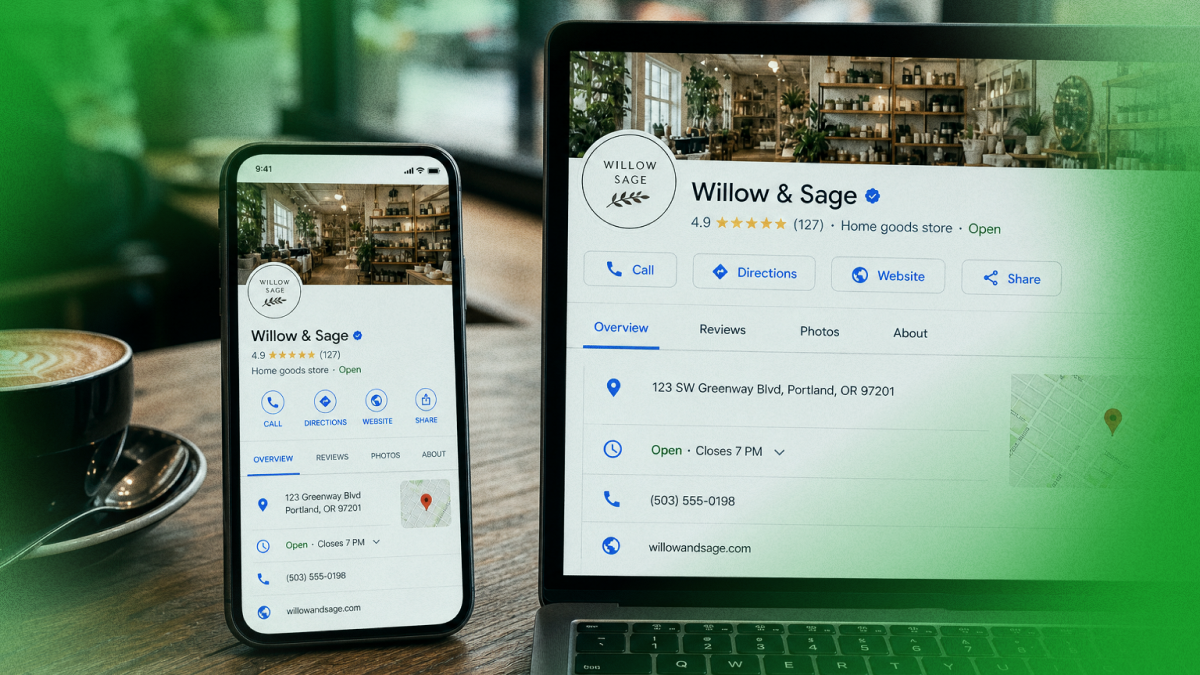
But there's a legitimate version of improving your GBP CTR: making your profile more compelling so real people who see it actually want to click. This includes things like having a complete profile with high-quality photos, a strong collection of recent reviews, accurate hours and contact information, and a business description that clearly communicates what you do and who you serve.
A higher GBP CTR from genuine engagement is a ranking signal. A higher GBP CTR from manipulation is a ticking clock.
What Actually Works for Local Rankings
The fundamentals of local SEO are less exciting than CTR manipulation but dramatically more durable. Here's what consistently moves the needle for small businesses trying to rank on Google Maps:
Google Business Profile optimization: A complete, accurate, and regularly updated GBP is the single highest-leverage thing a local business can do. Categories, services, photos, posts, and Q&A all influence rankings. Most businesses have significant room to improve here.
Review acquisition: The quantity, quality, recency, and response rate of your reviews are major ranking factors. A systematic process for asking satisfied customers to leave reviews at the right moment, through the right channel compounds significantly over time.
Local citations: Your business name, address, and phone number should be consistent across every directory where your business appears. Inconsistencies create confusion for Google's local ranking algorithm.
Local content: A website with pages specifically targeting your service area city pages, neighborhood pages, service-specific landing pages signals local relevance to Google in a way that a generic homepage doesn't.
Backlinks from local sources: A mention and link from a local newspaper, chamber of commerce, or neighborhood business association carries more local ranking weight than a link from a national directory.
This is exactly what Leapfy is built to help local businesses and agencies track and execute systematically monitoring your Google Maps rankings across the map grid, identifying where you're winning and where you have gaps, and helping you prioritize the work that moves rankings rather than guessing.
The CTR Manipulation Trap for Local Business Owners
Here's why CTR manipulation keeps coming up even though it doesn't reliably work: local SEO is slow, and the results from legitimate work are hard to attribute. You spend two months systematically getting reviews, building citations, and improving your GBP, and your rankings improve but you don't know exactly what caused the movement or when it will happen.
CTR manipulation offers a shortcut with a visible mechanism. You pay, clicks happen, and sometimes rankings move. The fact that the movement is often temporary and the risk is significant gets obscured by the narrative that "it worked for someone."
For most small business owners and the agencies that serve them, the time and money spent on CTR manipulation would produce better and more durable results if applied to the fundamentals.
FAQ
Is CTR manipulation illegal?
It's not illegal in a criminal sense, but it violates Google's Terms of Service. The consequences are business consequences ranking penalties, profile suspension rather than legal ones.
How do I improve my CTR legitimately?
Make your GBP more compelling: add high-quality photos, respond to every review, complete every section of your profile, and use posts to share current offers or updates. In organic search, a better meta title and description with clear value proposition improves CTR without any manipulation.
Can Google really detect CTR manipulation?
Yes, with increasing accuracy. Google has access to data about click behavior across billions of searches and has built sophisticated models to identify patterns that don't match genuine user behavior. The arms race between manipulators and Google's detection has consistently favored Google over time.
What's the fastest legitimate way to improve local rankings?
Getting more recent reviews is typically the fastest-moving legitimate lever. A business that adds ten genuine five-star reviews in a month will usually see ranking movement faster than from almost any other single action.
How long does legitimate local SEO take to show results?
For competitive markets, three to six months is a realistic timeline for meaningful movement. For less competitive local markets, results can come faster. The frustrating truth is that the timeline depends heavily on what your competitors are doing and how much ground you need to make up.
The local SEO space has a lot of noise. CTR manipulation is part of that noise a shortcut that sounds plausible, occasionally produces short-term movement, and reliably falls short of the durable results that come from doing the actual work.
Leapfy exists to make that actual work more systematic and measurable, so you can see what's working, where you're ranking across the map grid, and what to focus on next.
See how Leapfy tracks your Google Maps rankings and shows you what to do next →